Asked to deposit your own money to unlock your earnings? It's a task scam
An unexpected message offers easy online work. The first payments are real. Then the app asks you to deposit your own money to unlock earnings that were never there. Here's what to do.
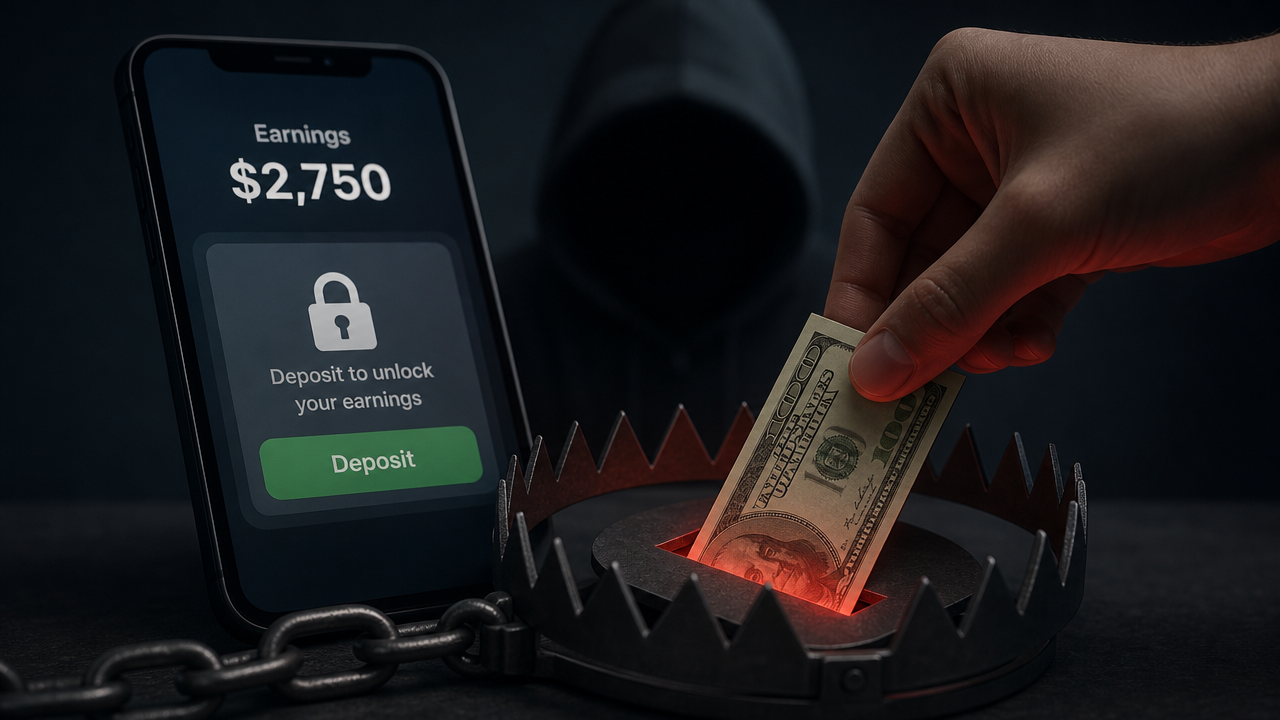
If an app says you have earned money but will not release it until you pay in first, stop before you deposit anything.
What's happening
A message turns up out of nowhere. Usually a text, a WhatsApp or Telegram message, sometimes a friendly "recruiter" on a social platform. The work sounds easy: like videos, rate product images, "boost products," complete "optimization tasks." A few minutes a day, paid for each one.
Then the first payments arrive. Small, but real.
That real money is the hook. These are task scams, sometimes called gamified job scams, and they are aimed at people looking for flexible or remote work. Students, parents, carers, people between jobs, people who have recently moved countries. The messages are written for exactly that hope.
The true scale is hard to measure, because most fraud goes unreported. In the United States, as one example, the Federal Trade Commission estimated around 20,000 task scam reports in the first half of 2024, up from roughly 5,000 in all of 2023. The same pattern shows up wherever people look for work online.
How it works
You get brought onto an app or website that looks like a real working platform. According to the FTC, tasks are often handed out in sets of forty, with the promise of leveling up once you finish a set, and the occasional "double task" that seems to pay a larger commission. Your balance climbs with every click.
Early on, you actually get paid. Those small payouts are what build your trust in the system.
Then it turns. To finish your next set, or to withdraw what you appear to have earned, you are told to deposit your own money, usually in crypto, to "charge up" your account. By then the balance on screen feels like yours, and worth protecting. So you pay.
If you hesitate, the pressure becomes social. People who stall are often added to a group chat where experienced workers share their success stories. Those workers are not real.
What this means for you
The app names change constantly. The way the scam runs does not.
The earnings you were shown never existed anywhere. They were a number on a screen, not money sitting in an account with your name on it.
The harder part is the design. The levels, the sets, the streaks, the balance you can almost reach: none of that is decoration. It borrows directly from gambling, because it makes stopping feel like losing. This is not carelessness on your part. It is a process run full time, on very large numbers of people.
Deposits made in crypto are difficult to reverse. Acting fast sometimes helps. Often it does not, and nobody honest will promise you otherwise.
What to do now
If the message has just arrived and you have not paid anything:
- Do not reply and do not tap the link. A reply confirms your number is active.
- Treat an unexpected job offer sent by text or messaging app as a scam by default. The FTC's advice is blunt on this: real employers do not recruit that way.
- No legitimate job asks you to pay in order to get paid. That single rule catches nearly all of these.
- Getting paid to like or rate things online is not real work. Honest companies do not offer it.
If you have already paid
You are not the first, and none of this is your fault.
Stop depositing. Whatever the next payment is called, whether it is an unlock fee, a tax, a clearing charge or a negative balance, it is the scam continuing. There is no final payment that releases your money.
Save your evidence first. Screenshot the chats, the platform, your task history, deposit records, wallet addresses and the web address. Accounts and group chats can be shut down quickly.
Contact your bank, payment provider or crypto exchange straight away. Tell them plainly that you were defrauded. Speed can matter. It is worth trying even when the odds are poor.
Report it. Reporting channels differ by country. Find the one for where you live on our Get help page.
Expect a second approach. People who lose money to task scams are often contacted afterwards by someone offering to trace or recover it for a fee. Treat that as the next scam rather than a way out.
Tell one person you trust. Carrying this alone tends to do the most damage.
One last thing
You went looking for work and someone built a machine to turn that into a loss. The shame for it belongs to them.