Prevention
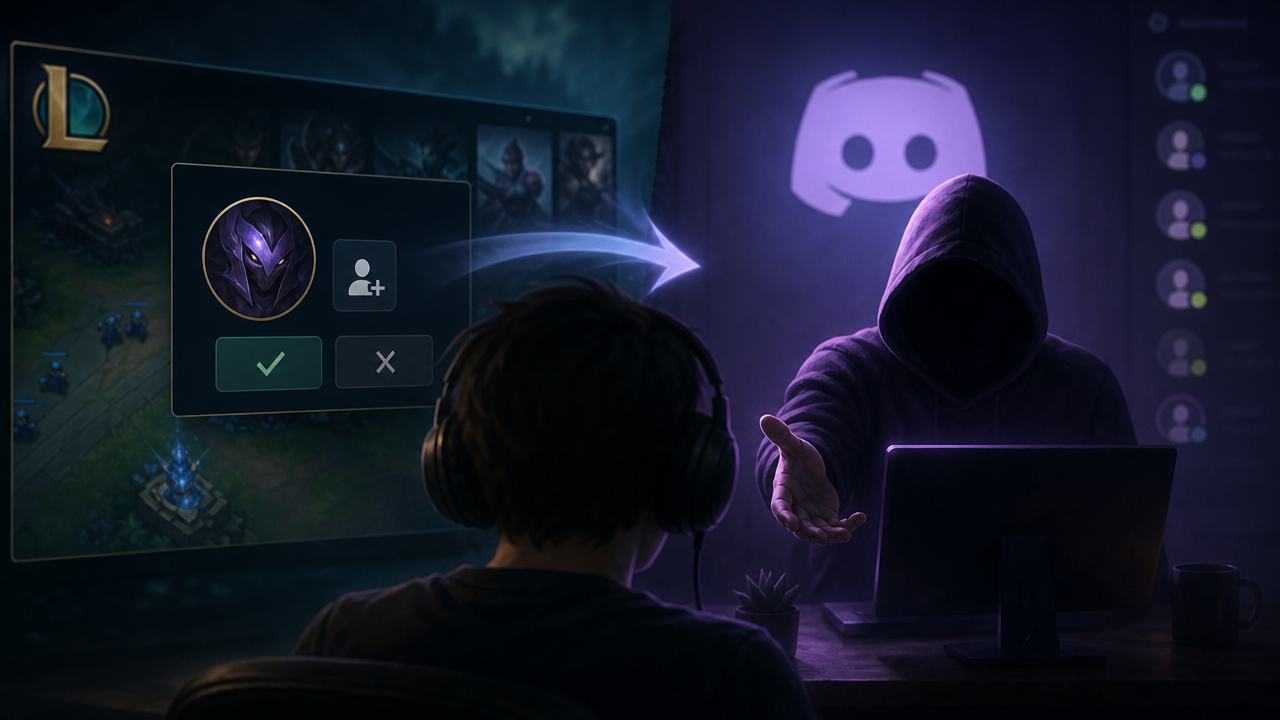
Random players are adding you on League, then moving you to Discord. Here's what they want.
A stranger compliments your game, adds you, then asks to keep talking on Discord. Sometimes photos follow. Here is what that approach usually is, and what to do before you reply.
Checked by Homer F on August 5, 2026
Still Online is not an emergency service. If you or someone else is in immediate danger, call your local emergency number.
It usually opens with a compliment.
Someone you just played with adds you and says you were the best player in that game. Or they ask if you are a smurf, which is the one question a ranked player will always stop and answer. Maybe they float the idea of duoing sometime.
Then, within a few messages, they want to move the conversation somewhere else. Discord, almost always.
If that has happened to you and something about it felt slightly wrong, that instinct is worth trusting. You are not being paranoid and you are not being rude. This is a known approach. It runs at scale, and the reason it feels personal is that it was written to.
It shows up in League of Legends, Valorant, CS2, Overwatch, Fortnite, Roblox, and just about anywhere else with a lobby and a friends list. The game changes. The script does not.
What actually happens, step by step
First contact is flattery, and it is calibrated. Not a generic hello. Something aimed at a competitive player: you carried, you were too good for that lobby, are you smurfing. It is designed to earn a reply, because a reply is all this stage needs. A variant skips the compliment and opens with something like "hi is this your main account," which does the same job by sounding like a question you should answer.
Then comes a reason to keep talking. A duo offer. Coaching. Someone to queue with. In practice the game rarely gets played. The offer exists to justify what comes next.
The move to Discord happens fast. This is the important step, and it is not a coincidence. Riot can see what happens in its own client. Nobody can see your Discord DMs. Moving you is how the conversation gets out of reach of the moderation that might otherwise catch it. It is also where more of your life is visible: your servers, your friends, the people you talk to.
On Discord, the warmth arrives quickly. A friendly persona, a first-name feel, an avatar that shows a bit of a real person. Small talk about champions you play. Homework, work, being bored. It reads as an ordinary conversation with an ordinary person, because that is the whole point.
Then images arrive that you never asked for. Sometimes early, sometimes after a day or two of chat. No request from you, no lead-up.
If you go quiet, they nudge. "Still there?" "Hello?" A message at midnight, another the next morning. Someone genuinely interested in you would eventually take the hint. A workflow does not.
The part most advice gets wrong
The standard warning is that these accounts give themselves away by not knowing the game. Ask about champions, ask about the meta, and the mask slips.
That is no longer reliable, and it may never have been. The persona can be completely fluent. Correct champion names, real complaints about a support who missed a ping, the right slang, the right emoji. Reading the conversation back, there is nothing to catch.
What does not survive a check is history. An account can talk about playing without ever having played. So look for evidence instead of asking questions: is there a match history, and are you in it? Is the account new? Are there any servers or friends in common? Knowledge is cheap and can be scripted. A record of actually existing is much harder to fake.
The second thing worth naming out loud is the photo.
An intimate image sent to you unprompted, by someone you have never met, is not flirting. It is an opening move. Most people feel some pull to respond in kind, or at least to stay in the conversation out of politeness, and that pull is the entire mechanism. The image was sent so that you would send one back.
Once you can see it as a transaction rather than a compliment, it stops working. That single realization is most of the defense.
Where this leads
Nobody can tell from a friendly message which of these they are in. The same opening feeds all of them.
Sexual extortion. Often called sextortion: blackmail using an intimate image or video of you, real or faked. Once something exists on the other end, the tone changes and the demands start, usually for money, cryptocurrency, gift cards, or game credits, sometimes for more images. The FBI describes this crime as capable of starting on any site, app, messaging platform, or game where people meet, and notes that offenders may run dozens of accounts and profiles at once, talking to many people simultaneously, and often pose as someone the target's own age. Its guidance specifically flags being asked to move to a different platform as a warning sign. This is not a niche problem and it is not limited to teenagers. Australia's eSafety Commissioner, reviewing the first five years of its image-based abuse scheme, found sexual extortion made up the largest share of reports, that most of those reports came from men, and that a majority came from people aged 18 to 24.
Police forces have also warned about a version where, after an exchange, a second person appears claiming to be a parent or a police officer, says the other party was underage, and demands payment to make the problem disappear. Treat that as part of the same scam rather than a new emergency.
A slow approach toward crypto or investing. Same opening, longer runway. Weeks of genuine-feeling friendship, no pressure at all, then a trading platform they are doing well on and would love to show you. The timeline is the tell.
Something to install. A game they want you to try, a private server, a tool, a link that is not from an app store. Some of these carry an infostealer, meaning software that quietly collects saved passwords, session logins, and wallet details from your browser.
Your accounts. The friendly approach can also be groundwork for account theft: a "moderator" who needs to sort out a report filed against you, a free skins or subscription offer that asks you to sign in, a support agent who exists only on Discord. Game companies do not handle account problems through Discord DMs.
Why this matters more than it looks
The reason they want you on a chat platform rather than in a game client is that a game client is anonymous. A chat platform is not. Your friends list, your servers, your username, the communities you belong to, sometimes your real name and workplace. That is leverage they can use. The threat in a sextortion attempt is never really about the image. It is about the specific people who would see it.
Which is also why nothing about this is a reflection on you. Being approached means you played a game and had a friends list open. That is all it means.
How to spot it
- A compliment or friendly opener from someone you have never spoken to
- Pressure, however gentle, to move the conversation to another platform
- No match history, or a match history you do not appear in
- A brand new account, or no servers and no friends in common
- Photos, intimate or otherwise, that you did not ask for
- A story that fits together very neatly, arriving very fast
- Repeated nudges when you stop replying
- Any request to install something, sign in somewhere, or talk to a "moderator"
You do not need all of these. One is plenty enough.
What to do
Before anything has happened
Do not reply, and do not accept. There is nothing to gain from seeing where it goes.
Send nothing back. That includes ordinary selfies and face photos, not only intimate ones. Skip video calls with people you have not met, because the other end can be recording.
Tighten the settings that let strangers reach you. Discord lets you control who can send you a friend request, with options for everyone, friends of friends, and server members, and you can deselect all of them. There is a separate setting that stops direct messages from people who share a server with you but are not on your friends list. Most games have similar controls for who can add or message you.
Take screenshots before you block, because blocking removes the conversation from your view. Then report the account on both platforms, the game and the chat app, and block it.
Consider whether your friends list needs to be public. It is often the thing that makes you worth targeting.
If you already sent something
Read this part slowly, because the panic is the weapon and it is worth putting down first.
You are not in trouble. You have not done anything wrong. What happened to you happens to a very large number of people, including careful ones, and it is a crime committed against you.
Stop replying. Do not negotiate, and do not pay. The consistent advice from authorities is to cut contact and refuse payment, including refusing to send money or further images. The FBI notes that in financially motivated cases the material is often released regardless of whether payment is made. Paying buys nothing and marks you as someone who pays.
Do not delete the conversation. It is evidence. Screenshot everything first: the messages, the profile, the username, the account ID, any payment details or wallet addresses.
Report the account to the platform, and report the crime through the proper channel for your country. You can find the right one for where you live on our Get help page.
If intimate images of you exist, StopNCII.org is a free tool that creates a digital fingerprint of an image on your own device and shares only that fingerprint with participating platforms so they can detect and block it. The image itself is never uploaded, and the site works in a long list of languages. It is for people who are 18 or over, who appear in the image, and who still have a copy of it, and the site lists its full criteria before you start. If the person in the images is under 18, there are dedicated services for that, and the Get help page will point you to them.
Be ready for a second approach. The FBI has warned about for-profit companies that charge sextortion victims large fees for help, use pressure and false information to secure payment, sometimes discourage victims from going to law enforcement, and in some reported cases appear to be connected to the extortion itself. If someone contacts you offering to make this go away for a fee, treat it as the next scam.
Tell one person you trust. Not for practical reasons. Carrying this alone is what causes the most damage, and it is exactly what the person threatening you is counting on.
An honest word about what happens next
Some of this is genuinely fixable and some of it is not, and you deserve the real version.
Reporting rarely leads to an arrest, because these operations are usually run from another country. Nobody can promise that an image which has already been sent somewhere can be pulled back everywhere. Tools like the one above are effective at stopping known images from spreading further, and they are worth using, but they are not a delete button.
What is also true, and gets said far less often, is that the threat to send everything to everyone is frequently not carried out. The threat is the product. Once it is carried out, the leverage is gone. That is not a guarantee and it is not a reason to wait quietly, but it is a reason not to make a decision from inside the worst hour.
A script found you. You did not invite it, you did not miss something obvious, and stopping to check was the right instinct. That is the whole story.
This happened to them too
First-hand accounts from people who went through the same thing.
My friend found a Facebook page full of AI deepfakes of her
“last night, i woke up to my friend spam calling me, and when i answered, i immediately heard sobs from the other side.…”
A video call on Snapchat became a $500 blackmail demand
“i’m literally shaking right now. i met this girl on bumble and we moved to snapchat and things got... heated. we did a…”